

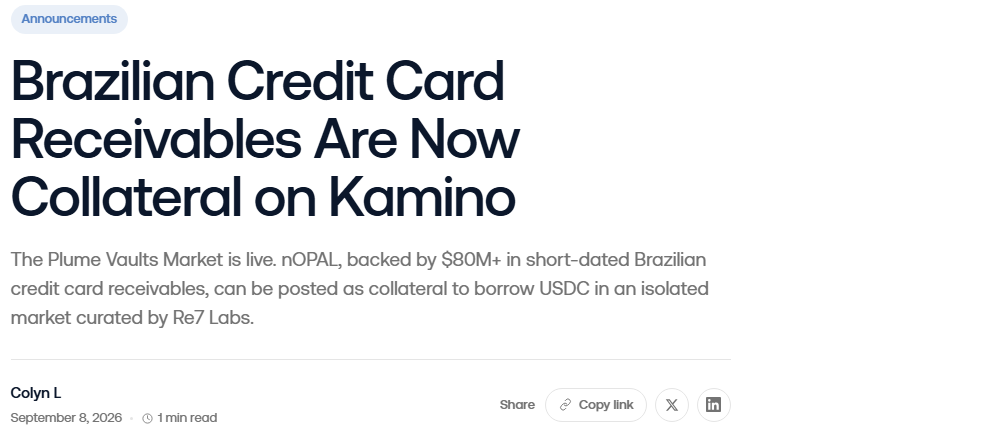
RWA credit markets got a concrete example worth pitching this month. It beats another abstract explainer. Kamino Finance’s Plume Vaults Market now accepts a token called nOPAL as collateral. The token is backed by more than $80 million in short-dated Brazilian credit card receivables. Holders can borrow USDC against it. That’s a real consumer credit market, tokenized, and a traditional lender would recognize it immediately.
RWA Credit Markets Need a Non-Crypto Comparison
A traditional finance reporter doesn’t need tokenization explained from scratch anymore. But they do need the specific asset explained in terms they already trust. Credit card receivables financing is a decades-old corner of consumer finance. Lead with that familiar structure. Then explain what’s different: the collateral sits in an isolated onchain market, not on a bank’s balance sheet.
This is the exact gap covered by pitching a sector traditional media doesn’t fully understand yet. The fix isn’t dumbing down the pitch. Find the traditional-finance analogy that already exists. Then build the crypto-specific detail on top of it. Leading with blockchain jargon just makes a generalist reporter stop and look things up.
A Named Curator Adds Real Credibility
Re7 Labs curates the Kamino market. That’s a named risk manager, not an anonymous smart contract with nobody accountable. A skeptical reporter cares about that detail. Reporters often ask who answers for an onchain market when something goes wrong. A named, reachable curator answers the question directly.
Get the Underlying Numbers Right, Every Time
An $80 million receivables pool is a specific, checkable figure. It will change as the pool grows or shrinks. Restating it six weeks from now without a fresh check invites a correction from a reporter who verifies details. The same care applies here as it does to explaining a token or asset model precisely enough that a journalist can cover it accurately. A fuzzy number does more harm than a smaller, accurate one.
How much can tokenized receivables back?
Try different loan-to-value ratios on a receivables pool.
The 60 percent ratio is an assumption. The real market’s limits are set by its curator.
This Pattern Will Repeat Beyond Brazil
Credit card receivables in one country is one instance of a broader pattern. Real consumer or business debt gets tokenized and posted as onchain collateral. Projects building similar structures elsewhere can reuse the pitch template. Still, each one needs its own country’s credit data and its own named curator. Copying wholesale won’t work.
News Coverage Agency spends a lot of its client work finding this exact traditional-finance angle for new RWA structures. Get in touch and let’s get your project’s translation right the first time.