
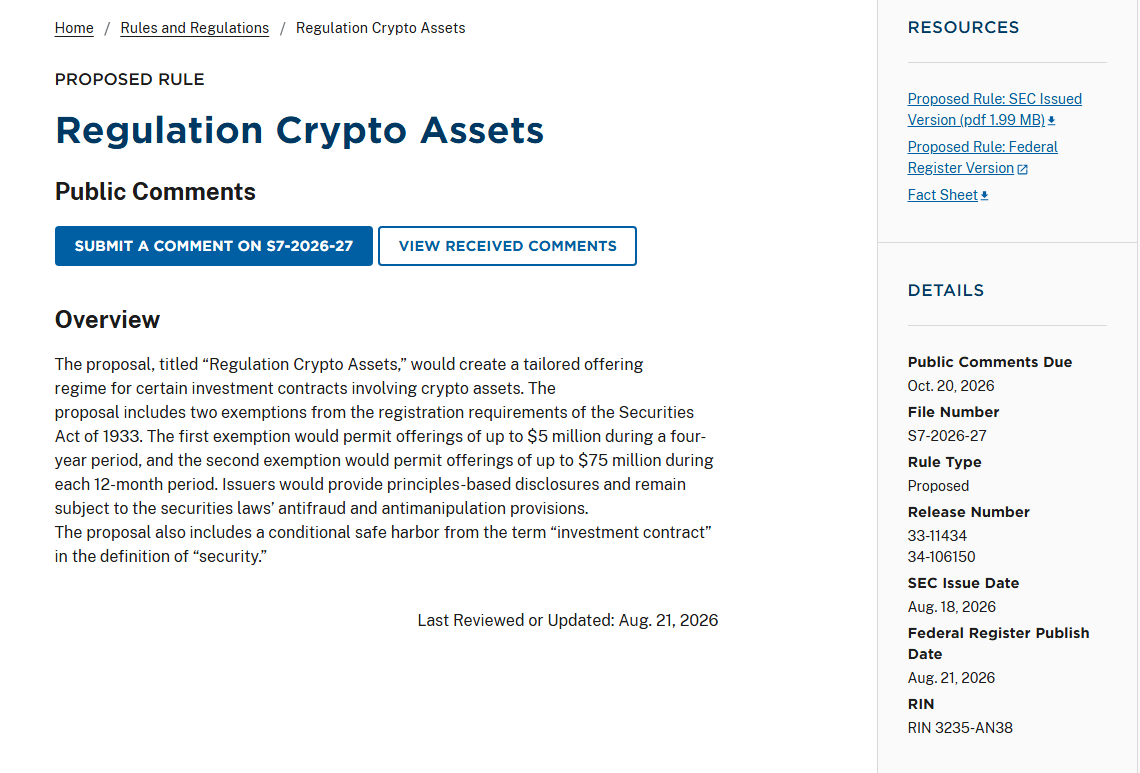
Regulation Crypto Assets is the SEC’s proposed offering regime for token issuers, published on August 18, 2026. Most of the coverage reads like it was written by lawyers for lawyers. Marketing teams barely got a mention. That’s a gap worth closing, because the proposal ties what a project says in public to what it has to disclose in private.
The headline numbers are simple. A startup exemption would cover offerings of up to $5 million over four years. A fundraising exemption would cover up to $75 million in any 12-month period, according to the SEC’s fact sheet. Inside that second exemption, Tier 1 tops out at 20 million dollars and Tier 2 at the full $75M.
Comments on Regulation Crypto Assets are due October 20, 2026. The proposal went into the Federal Register on Aug. 21. Anyone can file one, and a founder with a practical objection to how the rule treats announcements has as much standing as a law firm.
What Regulation Crypto Assets Means for a Roadmap Post
Here’s the part marketers should read twice. The safe harbor inside Regulation Crypto Assets works backwards from promises. An issuer qualifies once it has finished, or permanently stopped, every managerial effort it represented or promised to carry out. It also can’t be making new promises of that kind, and it has to file a public certification with its analysis attached.
Read that as a communications problem. A pinned thread saying the team will ship a new module next quarter is a representation. Posting a fresh one after the safe harbor filing could muddy the claim. That’s one reading of the fact sheet, not legal advice. Counsel should test it against the full proposing release, all 401 pages of it.
Teams that already follow a cautious approach to securities-sensitive wording will find this familiar. The difference is that the rule would turn habit into a measurable condition.
Your Whitepaper and Website Become SEC Evidence
Rule 103(a) of Regulation Crypto Assets says required disclosures must be consistent with the issuer’s public statements. The release names the website, official social media accounts and promotional materials such as whitepapers. It also asks issuers to clearly delineate forward-looking plans from current facts.
Picture the mismatch. The offering document says the token carries no governance rights. The X bio says community-governed. One of those will get quoted back at someone. A claims register fixes this cheaply, and it’s boring on purpose: one sheet listing every public claim, its date, its link and who approved it.
Supply numbers deserve the same treatment. If the story about supply changed in a podcast, the tokenomics narrative on the site needs to change with it. The filing too.
Testing the Waters Under Regulation Crypto Assets
Under the fundraising exemption, proposed Rule 304 would let an issuer gauge interest before the offering statement is qualified. Those messages count as offers for antifraud purposes. No money and no binding commitment can be taken yet. Written materials or broadcast scripts used this way would have to be filed as an exhibit to the Form 1-CRYPTO offering statement.
Translate that into marketing terms. A launch thread or AMA script used to measure interest could become a filing exhibit. The rule also covers any person authorized to act for the issuer, which pulls in agencies and paid creators. Anyone running a presale campaign or briefing KOLs on what they can say should put those limits in writing.
Public marketing isn’t banned, though. The release says general solicitation would be permitted under the startup exemption, and the fundraising exemption carries no prohibition on it after qualification. Reach stays open. Accuracy gets stricter.
In a statement that day, Commissioner Mark Uyeda said the proposal would replace the guesswork with fixed thresholds and defined disclosure obligations. For marketing teams, that means fixed questions someone will eventually ask about last year’s posts.
Token Marketing Checklist Before October 20
Regulation Crypto Assets: communications checklist
Tick each item as your team finishes it. This is a working list, not legal advice.
Nothing here is final. The comment period could change the thresholds, the disclosure content, even the communications rules. Still, teams that tidy their public record now won’t be scrambling later. For securities-sensitive disclosure habits that hold up under any version of the rule, start with the claims register.
News Coverage Agency helps token teams audit their public claims and plan launch communications around rules like this one. Get in touch before the next announcement goes out.