
ASCI isn’t a lawmaker. It’s a self-regulatory body. Even so, the ASCI crypto advertising guidelines are the closest thing India has to a rulebook for virtual digital asset ads, and they’re blunt about format. Any campaign aimed at Indian audiences runs into them fast.
The council issued them on February 23, 2022, for every VDA ad released on or after April 1 that year. Its own release adds one more date. Older ads shouldn’t stay in public view after April 15, 2022 unless they comply.
What the ASCI Crypto Advertising Guidelines Require
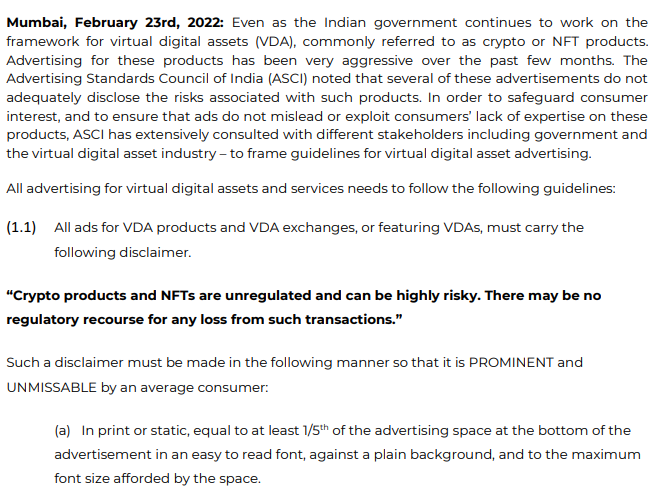
One disclaimer rules them all. Any ad for a VDA product or exchange, or one that features VDAs, has to carry it. The wording is fixed, and the screenshot above shows it word for word. In short, it calls the category unregulated and highly risky, then warns that a buyer may have no regulatory recourse after a loss. And it has to be prominent and unmissable to an average consumer, in the ad’s dominant language.
Placement Rules by Format
Print comes first. Under the ASCI crypto advertising guidelines, a static ad hands the bottom fifth of its space to the disclaimer. Think an easy font, a plain background, as big as the space allows. Video leans on time instead. The warning closes the ad, voiced at a normal pace, and it sits on screen for five seconds or more. Run past two minutes? Then it opens the video as well.
Audio isn’t far off. The line is spoken at the end, and again at the start once the audio runs past 90 seconds. Social posts are fussier. They need the disclaimer twice, in the caption and on any picture or video, and the caption copy has to come first, before the fold. Disappearing stories need a voiced version, though a video of 15 seconds or less can get by with a visible overlay.
But character limits get a shortcut. Where space is tight, ASCI allows a shortened warning that ends on the words unregulated and risky, followed by a link to the full text. Ad teams sometimes forget that the link has to lead somewhere that actually shows the complete disclaimer.
Words and Claims the Guidelines Rule Out
The ASCI crypto advertising guidelines also rule out four words for VDA products and services: currency, securities, custodian and depositories. ASCI’s reasoning is that consumers link those terms to regulated products. Because of that, a headline calling a token a digital currency breaks the rule on its own.
Claims get limited too. For one, no ad can promise or guarantee future profits, and past performance can’t be shown in a partial or biased way. Returns for periods under 12 months stay out entirely. A zero-cost offer has to count every cost a buyer would reasonably expect. Minors can’t appear dealing with the product, either. Nor can an ad present trading as a fix for money or personal problems, or imply it’s easy enough that nobody needs to think twice.
Two more points catch teams out. VDA products can’t be compared with any regulated asset class. And every ad must name the advertiser and give an easy way to make contact, a phone number or an email.
Influencers and Paid Posts Under the Rules
Item twelve asks celebrities and prominent people to take special care and do due diligence on the claims they voice. That puts weight on briefs. A clear creator briefing should pass on the exact disclaimer and the banned words. If the post is paid, the same labelling logic applies as in pricing and disclosure for sponsored placements.
Why a Self-Regulatory Code Still Matters
Compliance isn’t optional in practice, because the release speaks to advertisers and media owners alike. A publisher can decline an ad without the disclaimer, and a complaint can bring public attention. It also sits next to a wider official message. The government’s own notices describe crypto products as unregulated and highly risky, a point covered in the India media and compliance guide.
For a broader view, how disclosure rules compare across markets shows where India’s approach is stricter on format and where it’s looser on enforcement.
ASCI crypto advertising guidelines: campaign check
Run each Indian creative through these lines before release.
NCA reviews Indian campaigns against these lines before they go live. Send a creative for review and get the fixes in one pass.