

Crypto PR in India works differently from most markets. The audience is huge, the rules are unusual, and reporters bring tax and compliance into almost every conversation. But a pitch that ignores both sounds as if it came from another country.
Look at what a business desk actually runs. The Economic Times keeps a Crypto Corner inside ET Markets. On the morning of October 1, 2026, its lead story wasn’t a coin price. It was CoinSwitch’s FY26 result: profitability on an adjusted EBITDA basis, revenue up 150% to Rs 324 crore, and more than 2 crore users.

The lesson is plain. Indian business press covers crypto companies as companies, with revenue, users and margins. Still, a founder with numbers gets a hearing, while one with only a vision gets a polite reply.
Crypto PR in India Starts With the Right Desk
In most newsrooms, business and markets desks sit at the centre. Technology and startup desks tend to handle funding, hiring and product news, and crypto-native outlets cover trading and protocols. Because each wants a different first paragraph, the same announcement often needs three versions. Sorting outlets by what they’re for works as well here as anywhere.
Language is its own decision. For example, English reaches one set of readers, and Hindi or other Indian languages can reach retail audiences in a different way. Check which target outlets publish in more than one language. Then ask for those editions by name. It’s a small step that many global teams skip.
Tax and FIU-IND Questions Reporters Bring
Expect the tax question first in any crypto PR in India briefing. The Income Tax Department’s own summary says income from transferring virtual digital assets is taxed at a flat 30%. The only deduction is the cost of acquisition, and losses can’t be set off. Its TDS page, which reflects the Finance Act 2026, describes a 1% deduction on payments for transfers. The department’s VDA note adds thresholds of Rs 50,000 or Rs 10,000 depending on the payer, and a reporting duty for crypto-asset transactions.
Because reporters ask how a product handles all that, a one-page answer helps. It should say who deducts tax, what users see in their statements, and what the team reports. Skip any claim about ‘tax-free’ or ‘tax optimised’ anything.
Then comes compliance. On 9 September 2026 the Press Information Bureau said FIU-IND had sent notices to 15 virtual digital asset service providers under Section 13 of the Prevention of Money Laundering Act. It also issued takedown notices for apps and URLs it said were operating illegally.
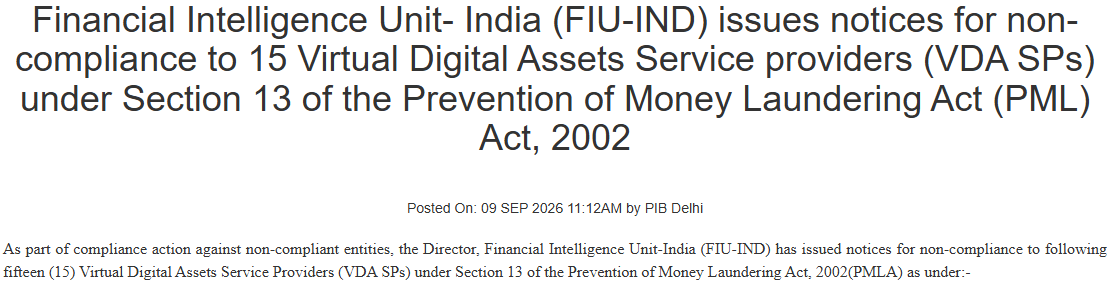
The same release states that obligations are activity-based and don’t depend on a physical presence in India. VDA service providers operating in India, offshore or onshore, must register with FIU-IND as reporting entities. PIB also tells the public that crypto products and NFTs are unregulated and can be highly risky. Registration status is now part of the story an offshore team has to tell.
Founder-Led or Agency-Led Pitching
Reporters tend to give a founder more room than a logo when the founder can speak to numbers and compliance. Practising the hard questions first pays off, because reporters will press on tax and registration. Agencies help most with introductions and timing, above all when the founder sits abroad. Be reachable in IST working hours. Otherwise a reporter will move on.
Compare approaches before choosing help for crypto PR in India. Three earlier pieces cover the trade-offs: crypto versus traditional agencies, PR firms working in India and the founders’ guide to crypto agencies.
A 90-Day Plan for Crypto PR in India
In the first thirty days, map outlets by desk and language and write the tax and compliance page. Next, pitch business and startup desks with real numbers and offer a founder for background calls. After day sixty, follow up, add regional-language editions, and publish what reporters ask most.
India media plan: first checks
Complete these before the first pitch.
News Coverage Agency has published for Indian and global crypto readers since 2021. The team can map the outlets and draft the compliance page with you. Ask about an India launch plan before the first reporter calls.