
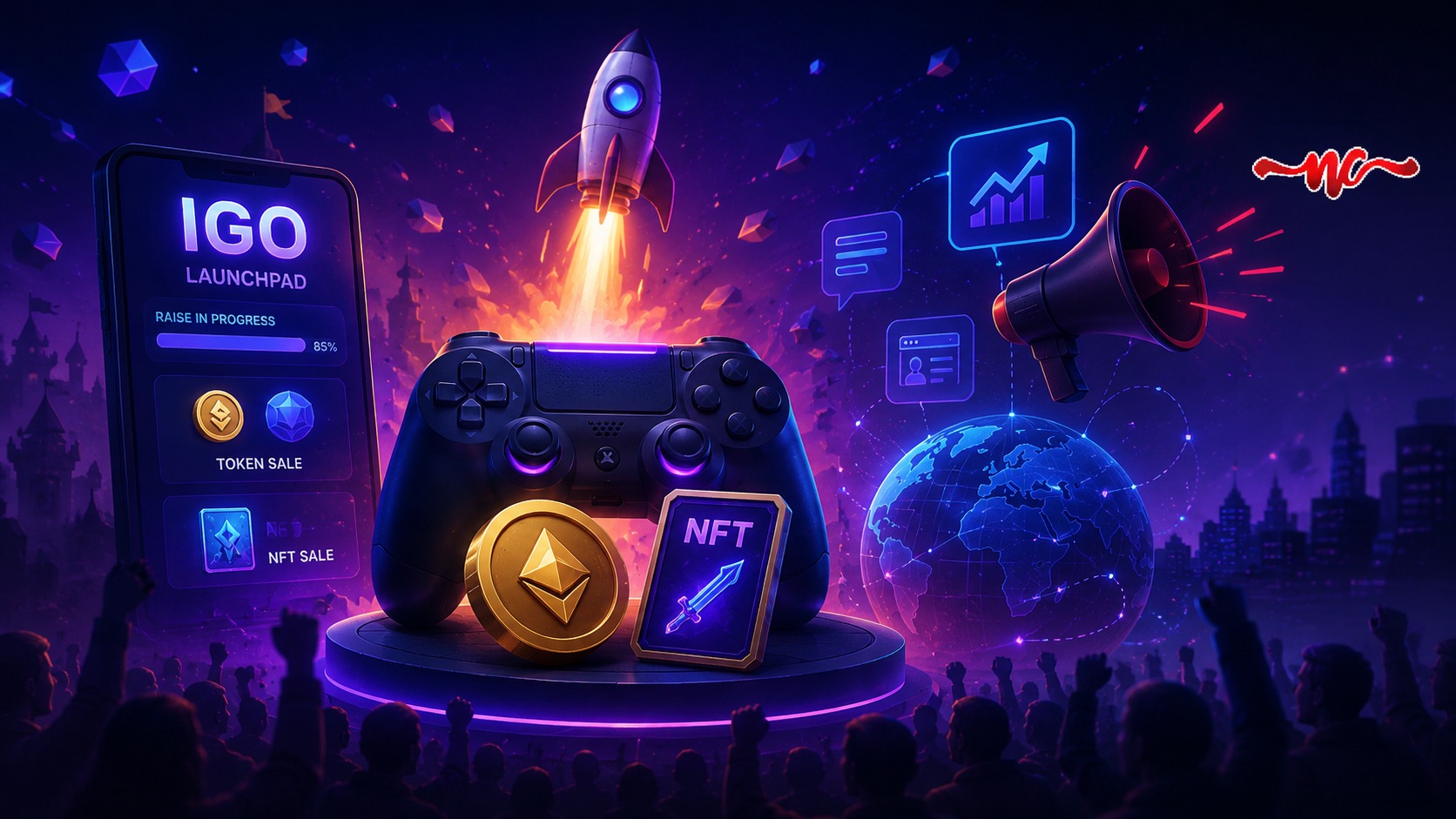
An Initial Game Offering (IGO) lets blockchain gaming projects raise funds by selling in-game assets or tokens before the game officially launches. Early investors receive NFTs, game tokens, or exclusive access in return.
Most founders treat the IGO as a finance event. It is not. It is a marketing event with a fundraising mechanism attached.
A successful IGO hinges on a robust marketing strategy — developers must engage potential investors through social media, forums, and blockchain events, while building a vibrant community to drive token demand. Without that, the numbers never materialize, regardless of how good the game is.
IGO vs ICO vs IEO — The Difference That Changes Your Entire PR Angle
This matters for PR because your pitch frame changes completely depending on which vehicle you run.
IGOs are similar to ICOs in that both are vehicles for raising capital for new projects — but IGO launchpads introduce game projects built on various blockchains, including Ethereum and Cardano.
The core distinction: with an IGO, buyers get one-of-a-kind digital assets they can actually use in the game world — not just speculative tokens. That tangibility is your story hook for journalists.
A typical ICO pitch to a journalist sounds like: “We’re raising to build infrastructure.” An IGO pitch sounds like: “We’re launching a play-to-earn economy where early holders own the weapons, land, and governance rights.” One lands. One gets ignored.
How IGO Launchpads Actually Work — And What Reporters Want to Know
The team applies to a launchpad such as GameFi.org or Seedify, where due-diligence checks cover team KYC, tokenomics soundness, and marketing readiness. Discord and Telegram communities are nurtured so that social metrics look healthy by the time whitelisting opens, because many pads allocate sale slots partly on community engagement.
GameFi was one of the first launchpads to apply IGOs for its games — it has launched over 50 gaming projects, including Drunk Robots IGO, Rebel Bots IGO, and Spellfire IGO. Other active platforms include Seedify (SFUND) and Enjinstarter.
Participation typically requires investors to lock the platform’s native token to gain access — making community size and token holder counts critical metrics both for launchpad tiers and for media credibility signals.
Journalists covering GameFi look for three data points before opening a pitch email: launchpad partner name, community size, and whether a playable demo exists. A Cointelegraph advisory warns that many IGOs raise on “conceptual early-stage” promises, leaving investors exposed if milestones slip — so journalists now default to skepticism on launch-day announcements without a demo.
The PR Gap That Kills GameFi Projects Before They Launch
Most Web3 game studios spend 80% of their budget on smart contract audits and token design. They allocate almost nothing to media strategy.
The result: a technically sound project with zero coverage and a Discord that flatlines two weeks before the IGO goes live.
GameFi PR is not standard crypto PR. Gaming journalists want gameplay hooks. Crypto journalists want tokenomics transparency. Both groups want a real story — not a whitepaper summary sent as a press release at 6 a.m.
The fix requires three layers running simultaneously:
1. Pre-IGO narrative seeding — Not a press release. A narrative arc. The studio builds visibility through interviews, founder-authored op-eds, and community milestones distributed over 6–8 weeks before the IGO date. Each piece creates a breadcrumb trail for reporters to follow.
2. Launchpad-native credibility signals — Coverage from launchpad announcement pages (Seedify blog, GameFi news) carries more weight with crypto media than a generic PR wire. Secure those placements first.
3. Demo-first pitching — No credible gaming journalist publishes on a game they cannot see. Even a 60-second gameplay video converts cold pitches into warm conversations.
You can see the same principle play out in traditional tech — our breakdown of B2B PR Strategy: How Tech Companies Get in the News covers how the story-before-product approach wins media slots across industries.
Pitch Templates That Actually Win Media Slots
Most IGO pitch emails die in the subject line. Below are two frameworks — one for crypto media, one for gaming media — with a real-structure breakdown.
Pitch Template A: Crypto/Web3 Media (CoinDesk, Decrypt, The Block)
Subject line: [Studio Name] IGO on Seedify — $X raised in private round, live gameplay demo attached
Body:
Hi [Journalist First Name],
[Game Name] launches its IGO on [Launchpad] on [Date]. The game is a [genre] built on [chain] — here is a 90-second gameplay clip: [link].
Three things make this worth a look:
— [Tokenomics differentiator: e.g., “deflationary burn tied to match completions, not just staking volume”]
— [Community proof: e.g., “14,000 Discord members in 6 weeks, 60% organic from GameFi community”]
— [Investor signal: e.g., “Backed by [VC name] — round details under embargo until 2026“]I can get you a whitelist allocation for testing plus a 15-minute call with the founder before the announcement goes live. Would that be useful?
[Your name]
Why it works: The subject line leads with the launchpad name — a known credibility marker for crypto reporters. The body front-loads the video link because journalists at crypto outlets skim. The three-point structure gives the reporter a ready-made outline. The whitelist offer creates exclusivity without any cost to the project.
Pitch Template B: Gaming Media (IGN, Polygon, PC Gamer — for blockchain crossover coverage)
Subject line: First look: [Game Name] lets players own in-game assets — IGO live [Date]
Body:
Hi [Name],
[Game Name] is a [genre] game where players earn, own, and trade verified assets on [chain]. Unlike most play-to-earn games, the economy is designed around [specific mechanic] — not just passive staking.
The IGO opens [Date] on [Launchpad]. We have a playable demo build ready to share under embargo, plus a 20-minute session with the lead game designer.
No blockchain knowledge required for coverage — the gameplay stands on its own.
Want access before it goes public?
Why it works: Gaming journalists are allergic to tokenomics language. This pitch leads with the game mechanic, not the fundraise. The line “no blockchain knowledge required” directly removes the barrier that stops gaming editors from assigning the story.
Guest Posting as an IGO PR Weapon
Guest posting is not a link-building tactic for GameFi projects. It is a trust-building infrastructure play.
When a CoinDesk editor receives a pitch from a studio nobody has heard of, the first thing they do is search the founder’s name. If the search returns zero published content, the pitch goes in the archive. If it returns two or three bylines in known Web3 publications, the email gets opened.
Guest posting creates that author footprint before the IGO window opens.
The right publication targets for GameFi guest posts:
- Hackernoon — accepts founder-authored technical explainers. A piece on “how we designed our token sink mechanism” builds credibility with both journalists and investors.
- Cointelegraph contributor program — high domain authority, direct audience overlap with IGO investors.
- BeInCrypto — strong GameFi readership, open to project team submissions with original data or gameplay analysis.
- Medium / Mirror.xyz — owned channels that rank on Google and feed into press kit credibility when a journalist checks the studio’s content history.
The ideal guest post structure for a pre-IGO window: one technical explainer (tokenomics or game design), one narrative piece (founder story or why the genre needed a Web3 model), and one community-facing post that targets long-tail search terms.
Our piece on Everyone Declared Guest Blogging Dead. Then Their Rankings Stalled. goes deeper on why guest posting authority compounds over time — and why projects that skip it pay double in paid media later.
The Community Signal Journalists Actually Check
Community size is a vanity metric. Community engagement rate is a media signal.
A project with 5,000 Discord members posting 200 messages a day looks better to a crypto journalist than a project with 40,000 members and four messages a week. Reporters check this. Launchpads check this. Investors check this.
The PR strategy here is straightforward: seed the community with content before the community exists. AMA announcements, gameplay teaser threads, and tokenomics explainers posted in the studio’s own channels create a content archive that makes a thin community look active and informed.
The goal is not to fake engagement. The goal is to make every real community member feel like they are part of a serious project — because serious community members generate organic engagement that journalists notice.
Blockchain PR Services That Handle the Full IGO Window
Running IGO PR in-house while building a game is not sustainable. Most studios reach the IGO date with a backlog of press materials that never got distributed, journalists who were never contacted, and a community that grew despite the PR strategy rather than because of it.
A specialized blockchain PR agency handles media outreach, pitch writing, guest post placement, community narrative seeding, and launchpad-adjacent coverage — all coordinated against the IGO timeline.
See how the full service model works in our Blockchain PR Services: The Complete 2026 Playbook for Visibility — and why projects that start PR eight weeks before the IGO close outperform those that start at announcement.
You might also like: