
The GENIUS Act marketing rules decide what a stablecoin issuer can say in public, and they’re stricter than most launch decks assume. The GENIUS Act marketing rules sit in the statute itself, not in future guidance. Treasury added a proposed rule on August 18, 2026, which touches advertising and presales too.
Most commentary stays on reserves and licensing. Copywriters and community managers get left with a hazy sense that ‘regulated’ is a safe word. It isn’t always. A few sentences in Public Law 119-27 turn ordinary promotional phrasing into a legal problem.
What the GENIUS Act Marketing Rules Ban Outright
Section 4(a)(9) has two limits. A permitted issuer can’t use terms tied to the US government in a coin’s name, including ‘United States’, ‘United States Government’ and ‘USG’. And it can’t market the coin in a way a reasonable person would read as legal tender, US-issued, or guaranteed or approved by the government. Currency abbreviations like USD are carved out.
Notice the test. It’s the reasonable person, not the lawyer who reads the footnote. A hero banner can fail even when the terms page says the opposite.
Words That Imply a Government Guarantee
Section 4(e) goes further. Payment stablecoins can’t be backed by the full faith and credit of the United States. They also can’t be guaranteed by the government or covered by FDIC deposit insurance or NCUA share insurance. It’s unlawful to represent that they are. The penalty ties back to Section 18(a)(4) of the Federal Deposit Insurance Act or 18 U.S.C. 709, as applicable.
That catches more than a loud ‘government-backed’ headline. ‘Bank-grade safety’, ‘federally protected’ or a seal that looks official could all invite the question. Teams already working through how a stablecoin builds trust without overpromising have a head start, since boring wording is the safe wording here.
The $500,000 Penalty Attached to Marketing
Section 4(e)(3) adds the sharpest of the GENIUS Act marketing rules. It makes it unlawful to market a product in the United States as a payment stablecoin unless it’s issued under the Act. Anyone who knowingly and willfully participates in a violation can be fined up to $500,000 for each one by Treasury. Separate acts count as a single violation when they come from the same statement or publication.
Read the verb. Participates. On its face the language isn’t limited to the issuer, which means agencies, exchanges and creators running promotions deserve the same briefing. That’s a reading of the text, and counsel should confirm it. Anyone weighing securities-style limits on token claims will recognise the pattern.
US Targeting in Treasury’s August Proposal
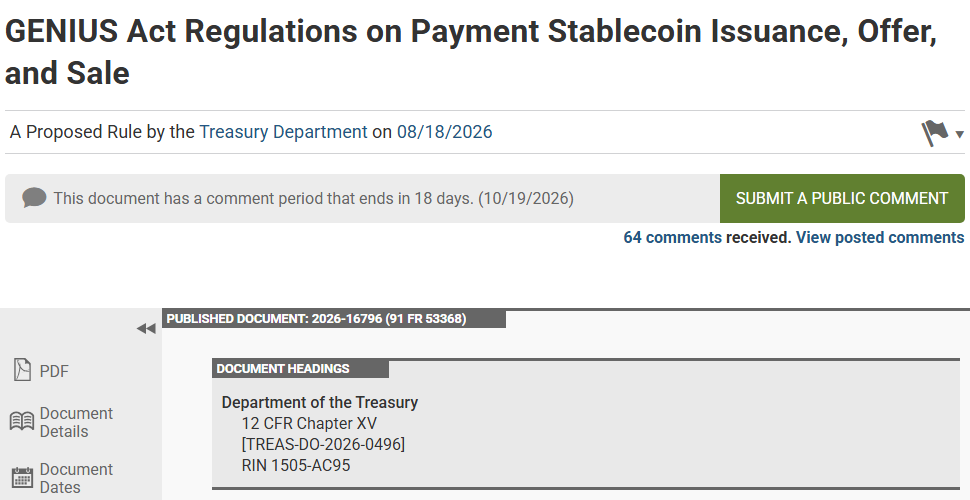
Treasury’s proposed rule, published as 91 FR 53368, implements Section 3, and comments are due October 19, 2026. It lists examples of an offer or sale. Directly soliciting someone in the US counts. Advertising a coin as available to US buyers counts too, as does advising people how to dodge location checks.
One condition in the proposal bars advertising or solicitation that targets anyone located in the US, or could reasonably be expected to have that effect. Treasury also says an offer includes presales of coins not yet issued. And in a worked example, an airdrop to a US resident as part of a marketing strategy counts as an issuance in the US.
The preamble goes on to say Treasury could look at activity meant to promote or create demand in the US. It names US-directed ads, liquidity incentives, merchant enablement and US-facing wallet integrations as examples. Under these rules, geo-targeting settings matter as much as headlines for foreign issuers. A related disclosure fight is playing out in the SEC’s separate token offering proposal, where public statements also have to match filings.
One more date for planners. Beginning July 18, 2028, the proposal notes, digital asset service providers can’t offer or sell a payment stablecoin to US persons unless a permitted issuer issued it. Exchange listing copy will need a check by then.
A Wording Check Before You Publish
GENIUS Act marketing rules: wording check
Run every landing page, thread and partner post through these five lines.
None of this replaces legal advice, and the Treasury text is still a proposal. But the statute’s marketing limits are already law. Disclosure habits that hold across regimes and a look at how MiCA treats the same kind of claims give teams a base to build from.
News Coverage Agency reviews stablecoin launch copy, partner announcements and creator briefs against rules like these. Talk to the team while the copy is still a draft.