

Every crypto press release quote starts life the same way. Someone senior is asked for a line, and a draft shows up that says they’re excited. Reporters have read that sentence a thousand times, so they skip it.
Most release guides give quotes one line of advice. This post gives them the whole page, using two real releases from October 1, 2026 as the worked examples.
What Makes a Crypto Press Release Quote Usable
A usable quote does one of three jobs. It gives a reason, an opinion or a view of what’s next. It doesn’t repeat the lede. Also, if the quote could be swapped into a release about a different company, it’s filler.
Take the Copper release on its Hyperliquid trading interface. Its co-CEO is quoted saying markets don’t stop moving because it’s the weekend, and that responding to information as it emerges is a better way to manage risk. That’s a reason. A reporter can use it because it explains why institutions would want the product.
Quote Versus Boilerplate: Spotting Filler
Filler comes in a few shapes. Praise for the partner. Gratitude for the team. A mission statement that belongs in the About paragraph, which the boilerplate guide covers. But none of it gives a reporter something new.
Try a blunt test. Delete the quote and read the release again. If nothing is lost, the quote was decoration. Still, if a fact vanishes with it, then the quote is carrying real weight, and you should keep it.
Two Quotes That Don’t Repeat Each Other
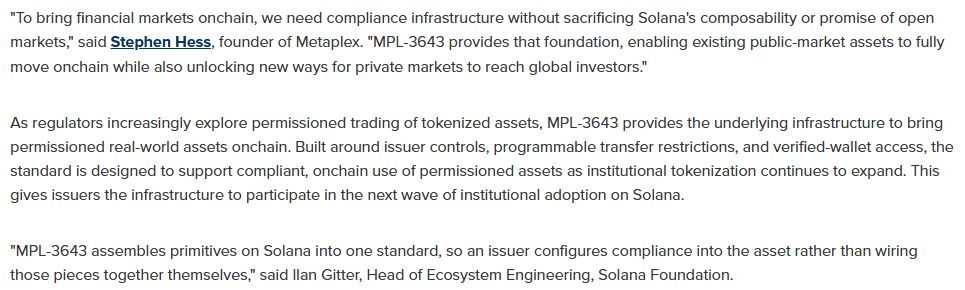
The Metaplex release shows a smart split. Its founder speaks to the business case, saying compliance infrastructure is needed without sacrificing open markets. A Solana Foundation engineering executive then speaks to the build, saying the standard lets an issuer configure compliance into the asset instead of wiring the pieces together. Because of that, the two quotes never overlap.
That’s the pattern to copy. One quote from the company on why. One from a partner, customer or technical lead on how. A second quote that repeats the first just adds length. Next, check that the partner approved their words.
Technical Versus Business Quotes
First, pick the speaker by the question being answered. A founder or CEO can speak to strategy and the market. An engineer or product lead can explain how something works, in plain words. Reporters covering a protocol often prefer the second voice, because it’s easier to verify.
Keep jargon to what the reader needs. A quote isn’t the place to define terms, so define them in the body and let the speaker react. And since people sound stiff when reading a draft aloud, media training for founders helps them say it in their own voice.
Approval Chain and Fact Checks
Every crypto press release quote needs the speaker’s approval, in writing. Then legal should check any claim about market share, volume or regulation. In the Copper example, a statement that Hyperliquid handles a large share of decentralised perpetuals volume sits in the body, with its own sourcing question.
Keep the chain short, though. Draft, speaker edit, legal check, final sign-off. And keep the approved version on file, because reporters will quote it back to you. Thought-leadership programs follow similar steps, as the founder visibility guide explains.
Marking Up a Draft Line by Line
Here’s an invented line: we’re thrilled to partner with an exchange on this exciting launch. Mark it up. Thrilled is filler, exciting is filler, and the partner is already in the headline. Rewrite it with a reason: this gives our users one place to settle across two chains, which they’ve asked for since spring.
Next, check the result against the fact page. Is the claim supportable? Can the speaker say it with a straight face? If so, send it. That habit carries over to writing a tighter release headline and to the rest of a full release walkthrough.
Crypto press release quote: filler test
Run each quote through these lines before approval.
NCA drafts and tests release quotes for crypto teams, with a filler check on every line. Send your draft quotes and get back versions a reporter can run.