
A token buyback announcement used to be a marketing decision. Since late September 2026 it’s also a wording decision with an SEC staff answer attached. The staff’s crypto FAQ, issued on September 25 and updated on the 28th, speaks directly to what a buyback post can imply.
The change was small on paper. The Division of Corporation Finance added four words to one answer. For anyone writing a token buyback announcement, those four words moved the line.
What the SEC Said About a Token Buyback Announcement
Question 2.5 in the staff FAQ notes that issuers run buybacks for treasury management, supply reduction, protocol-funded burns and rebalancing. It then asks whether announcing one is a representation or a promise to undertake essential managerial efforts. That phrase matters because such a promise is one way a token sale can be treated as an investment contract.
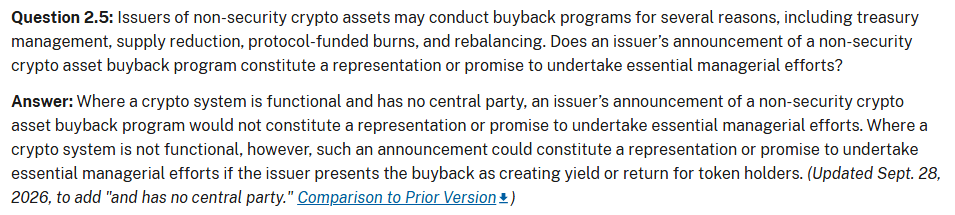
The answer has two halves. Where a crypto system is functional and has no central party, announcing a buyback for a non-security crypto asset would not be a promise of essential managerial efforts. Where the system isn’t functional, it could be, if the issuer presents the buyback as creating yield or return for token holders.
The September 28 update added the words ‘and has no central party’ to the first half. Unchained reported that this narrowed the guidance to networks without a central party. The FAQ also says plainly that it’s staff opinion with no legal force. It isn’t a rule, and the Commission hasn’t approved it.
Facts to State: Source of Funds, Cap and Schedule
A good token buyback announcement reads like a procedure, not a promise. Say where the money comes from, whether that’s protocol revenue or the treasury. Give a maximum amount and a time window. Name the method, open market or a single purchase. And say what happens to the tokens afterward, burned or held.
Reporters will test those details against the chain. What journalists check before they publish explains why a vague amount invites a question that a transaction hash would have answered.
Language That Reads Like Yield or Price Support
The FAQ’s own trigger is presenting a buyback as creating yield or return for holders. Marketing copy drifts into that territory easily. ‘Rewarding holders’, ‘value accrual’ and ‘a floor under the price’ all describe a benefit, not a mechanism.
Swap the benefit for the mechanism. ‘The protocol will use up to a stated share of monthly fees to repurchase tokens on the open market’ says what happens. It doesn’t say what the price will do. That distinction runs through how teams talk about a token’s economics more broadly, and it follows the habits behind securities-sensitive wording.
Reporting Executed Buybacks Onchain
Once the program starts, publish the wallet addresses and transaction links. Post a short summary at a fixed rhythm, monthly or quarterly. If a month is skipped, explain why. Silence reads as a change of plan.
Open-market programs and one-off purchases need different notices. A program needs a start, an end and a cap. A single purchase needs a date and an amount, and no suggestion that more will follow. Mixing the two is how a token buyback announcement turns into an open-ended promise.
The same idea of essential managerial efforts shows up in the SEC’s separate proposal. The safe harbor in Regulation Crypto Assets depends on an issuer ceasing such commitments and adding none. Buyback wording could matter twice, once under the FAQ and once if that rule is adopted.
A Review Checklist for Counsel
Token buyback announcement: pre-publication check
Hand this to counsel with the draft.
This isn’t legal advice, and staff guidance can change again, as the September 28 edit showed. Investor-style updates after launch are easier when the first announcement was careful.
NCA drafts buyback and treasury notices with counsel in the loop and reporters in mind. Send the draft over before it goes on the forum.