
The VARA marketing rules decide who may promote virtual assets in Dubai, what they must say, and what they can never imply. They’re written in plain, specific terms, which makes them easier to follow than most crypto advertising regimes. But they’re also stricter than many teams expect.
What follows reads the text of VARA’s Marketing Regulations 2024 as published in its rulebook. It isn’t legal advice, and the regulator can update the rules, so check the live version before any campaign.
Who May Market Under the VARA Marketing Rules
Marketing a virtual asset activity in or at the UAE is limited to a VASP licensed for that activity. Otherwise it must be done on the VASP’s behalf and with its approval. An agency can’t promote a licensed activity on its own authority. Marketing anonymity-enhanced cryptocurrencies, or activities involving them, is strictly prohibited.
There’s one carve-out for outsiders, though. An entity is exempt if it’s not in the Emirate and conducts no virtual asset activity there. It must also carry out no marketing aimed at the UAE. All three conditions must hold together.
What Marketing Must Not Say or Imply
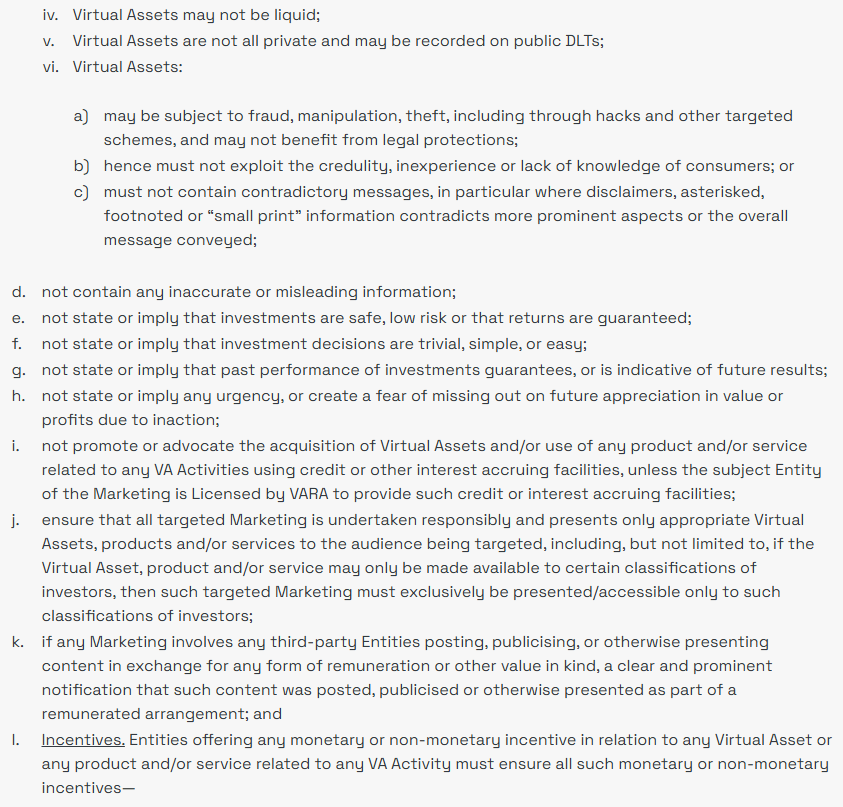
The general requirements run through a long list. Copy must be accurate and identifiable as promotion. Also, it can’t contradict the stated risks. Those include loss of value, irreversible transfers, and total loss with no financial protection.
Then come the bans on implication. No claim that investments are safe or low risk, or that returns are guaranteed. Investing can’t be called trivial, simple or easy, either. Past performance can’t be presented as a guarantee of future results. And nothing that creates urgency or fear of missing out on gains from inaction.
Two more catch common habits. Marketing can’t push buying with credit or interest-bearing facilities unless the firm is licensed to offer them. And small print can’t contradict a bolder message, since the rules single out disclaimers and footnotes that do exactly that.
Disclaimers, Calls to Buy and Wallet Drops
Marketing a virtual asset adds further rules. It must not include a call to buy or sell. It must carry a prominent disclaimer that value can be lost in full or in part and that volatility can be extreme. And it must say clearly that an investor can lose everything and gets no financial protection.
The rules also bar sending a virtual asset to a wallet without prior consent or a clear expression of interest from its owner. Because of that, teams planning a drop should read that line twice, along with the VARA marketing rules on incentive campaigns and points seasons.
Influencers, Paid Posts and Incentives
Content posted by a third party in exchange for payment or value in kind needs a clear notice. That notice must show it was a paid arrangement. The text labels key opinion leaders as a group that can’t use the journalism or education exemptions, so they must follow the rules in full.
Incentives get their own test under the VARA marketing rules. They can’t divert investors from considering the risks, they must run long enough, and they need a compliance confirmation from VARA. Creator budgets are covered in pricing for sponsored placements, and briefs belong in a creator briefing guide.
Agencies, Records and Exemptions
When a third party markets on a firm’s behalf, the instructing firm stays responsible at all times. The agency, however, must take commercially reasonable steps to comply. It must check that the client may market in the UAE and get approval before acting. And it can be held liable itself for failing to do so.
Next, records matter in the VARA marketing rules. Entities must keep a record of all marketing and its distribution. The minimum is eight years from the last run, and VARA can ask to see it.
Still, narrow exemptions exist for journalism and education, and each comes with conditions. The content’s overall purpose can’t be marketing, and an author must disclose any interest in the assets covered. For the media side of the same market, see the Dubai media guide and, for a comparison, India’s ASCI guidelines.
VARA marketing rules: campaign check
Run each Dubai-facing asset through these lines.
NCA reviews Dubai-facing campaigns, creator briefs and release drafts against the VARA text. Request a VARA copy review before the campaign calendar is locked.