
Ask ten founders what is crypto marketing and you’ll get ten answers, usually a list of tools. Here’s a plainer one. Crypto marketing is getting people to understand, trust and use a blockchain product or token. The rules are stricter than almost any other industry faces.
That last part is what makes it different. If you skip it, the rest is generic marketing with a coin logo on top.
What Is Crypto Marketing in Practice?
What is crypto marketing in practice? One job. Move a stranger from “never heard of it” to “tried it, works.” At an exchange, that means a funded account. At a DeFi protocol, a first deposit. An NFT project wants a mint, and a wallet wants a first transfer.
The tools are familiar: content, community, public relations, partnerships, influencers, events, search. But what changes is how much weight each one carries, and which doors are closed.
Why the Usual Playbook Breaks
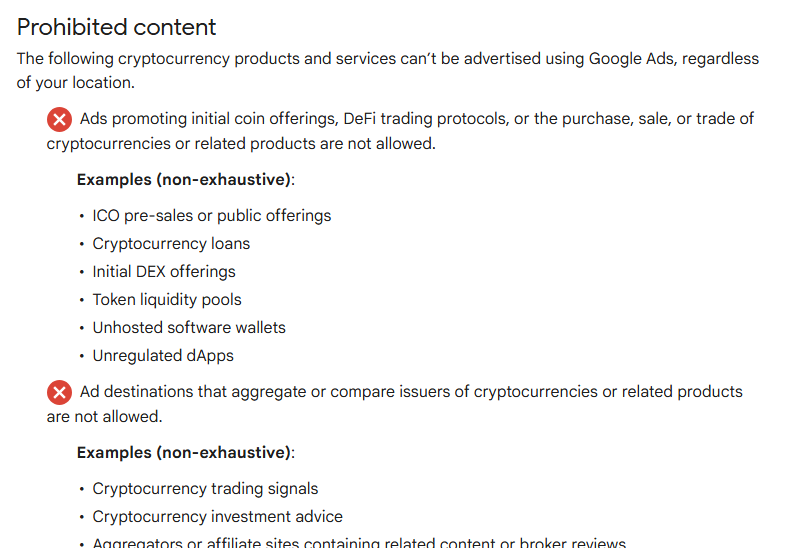
Start with paid ads, the easiest lever in most industries. Google’s cryptocurrencies policy says ads promoting initial coin offerings, DeFi trading protocols, or the purchase, sale or trade of cryptocurrencies are not allowed, whatever your location. Its examples include ICO pre-sales, token liquidity pools and unhosted software wallets. Exchanges and wallets can only be promoted after Google approves an application. Advertisers also have to check the rules of every country they target. Read the full Google policy before you budget a cent.
Meta runs a similar gate. Its advertising standards bar promotion of trading platforms, swapping and staking services and other crypto products without prior written permission. To get it, advertisers show a regulatory licence. The wording sits on Meta’s cryptocurrency page.
Not everything is blocked, though. The same Google page allows educational material about crypto, as long as it doesn’t offer investment advice, tips, odds or trend analysis. That one line explains why many crypto brands sound like teachers.
Five Jobs Crypto Marketing Actually Does
Because paid reach is narrow, most crypto marketing moves to earned and owned channels. Think of five jobs.
Explaining. Most people can’t say what a rollup or a restaking vault does. Clear articles, short videos and docs that a beginner can read are marketing, not a side task.
Proving. Because anonymous teams, collapsed projects and hacks taught buyers to doubt, proof matters. Audits, public wallets, a named team and third-party coverage do more than any slogan. This is where public relations earns its keep, and the media tier guide shows which outlets carry weight with which readers.
Gathering. A project without a community has no distribution. Telegram, Discord and X are where users ask questions before they buy, and when a team answers fast it wins them. We covered the mechanics in a Discord growth piece.
Borrowing trust. New projects use creators and partners whose audience already believes them. That works only when the pairing makes sense and the paid relationship is disclosed. The difference between big names and small ones is laid out in this KOL comparison.
Staying legal. Rules differ by country, and a launch that’s fine in one market can be a problem in another. A European team, for example, has to think about MiCA wording from day one, while others can wait. See the MiCA marketing note for how that plays out.
Product Marketing Versus Token Marketing
Here’s a split newcomers miss. You can market the product, meaning what people do with it, or the token, meaning the asset tied to it. Each needs its own language, and each needs different care.
Product marketing talks about use: faster settlement, lower fees, a feature that’s live today. Token marketing drifts quickly into promises about value, and that’s where regulators and platforms push back. Keep the two apart. Say what the product does, say what the token is for in plain terms, and leave price talk out entirely.
Where to Start With Crypto Marketing
Before anything else, don’t buy reach. Build a base people can verify: a clear website with named people on it, documentation, a place to ask questions, and one or two independent articles about you. Then widen from there, because what is crypto marketing worth without proof behind it?
A sensible order: fix the explanation first. Next, open one community channel and staff it. After that, pitch two or three relevant reporters with something checkable. Test creators or events only once you know what converts. Measure real actions, like wallets connected or deposits made, never follower counts.
If you’d rather not work it out alone, NCA writes and pitches crypto stories for teams at this stage. Tell us what you’re launching and we’ll suggest a first ninety days.